Planning guide
Driving to the Costa Brava
Most families who holiday on the Costa Brava drive there. It's a long way — but with a sensible route and a night's stop along the way, the journey becomes part of the holiday rather than an ordeal. Here's what you can plan for now.
How far is it?
The Costa Brava starts just over the French–Spanish border and runs south to Blanes. From Brussels you're looking at roughly 1,300 km to the northern end of the coast; from Amsterdam or Utrecht, closer to 1,500 km. The exact figure depends on your route and on where along the coast you're heading.
That's too far to drive comfortably in one go with children. Most of it is motorway through France, so the route itself is straightforward, but it's a very long day. Spreading the drive over two days is the single best decision you can make.
The route through France
Almost every route ends the same way: down the Rhône valley past Lyon, along the Mediterranean via Montpellier and Perpignan, and over the border at Le Perthus into Spain. Getting as far as Lyon, there are roughly three options:
- Via Paris. South past Paris, then down the A6 to Lyon. Traffic around Paris can be very slow.
- Via Luxembourg. Through Luxembourg and past Metz, Nancy and Dijon, joining the A6 before Lyon. It avoids Paris altogether.
- Via the Massif Central. Some families take the A75 via Clermont-Ferrand and the Millau Viaduct. Much of that motorway is toll-free and the scenery is stunning, but the route is hillier and usually takes longer.
Which one is quickest depends on where you set off from and on the traffic that day. Compare them in your navigation app just before you leave.
Tip: From Lyon onwards the motorway gets busy on summer weekends. A navigation app with live traffic earns its keep on this stretch.
Splitting the drive with an overnight stop
An overnight stop turns one gruelling drive into two manageable days. There are two ways to think about where to stop:
- Halfway. Roughly in Burgundy or around Lyon. Both driving days are about the same length — good if nobody fancies one very long stint.
- Further south. In the Rhône valley or the Languedoc. The first day is longer, but the second is short: you reach the coast with most of the day ahead of you, and with energy left for unpacking and a first swim.
Hotels near a motorway exit are the easiest option: quick to find, and quick to get back on the road in the morning. A campsite or holiday cottage near the route has more charm but costs more time. Whatever you choose, book well ahead for July and August, and pick somewhere you can park without driving into a city centre.
Tip: If your route or overnight stop takes you into a French city, check beforehand whether you need a Crit'Air clean-air sticker. The rules vary from city to city.
Tolls and traffic in France
Most French motorways are toll roads (péage). On a journey this long it adds up, so include it in your budget. Look up the current cost of your route with a toll calculator before you go.
- Keep a credit card within reach. Paying by card is the norm at toll booths, but not every bank card is accepted everywhere.
- A télépéage tag, ordered in advance, lets you use the dedicated lanes marked with a 't' and saves queuing at busy barriers.
- Check Bison Futé, the French traffic forecast. It colour-codes the busiest travel days; Saturdays in July and August are notorious.
- If you can travel on a weekday, do. On a busy Saturday the difference can easily be hours.
- Check what you're required to carry in the car in France and Spain, such as hi-vis vests. The rules differ per country and change from time to time.
Travelling with children in the car
The motorway is the easy part. Keeping everyone on the back seat cheerful for a day and a half is where planning pays off.
- Stop every two hours or so. French motorways have rest areas at regular intervals. An aire de repos has toilets, picnic tables and sometimes a small playground; an aire de service adds fuel, food and a shop.
- Pack a car bag. Snacks, water, wipes, a change of clothes within reach, and something new for each child to do: a book, a card game, downloaded episodes and headphones.
- Keep the heat out. Sunshades for the rear windows and plenty of water. The further south you get, the faster the car heats up at every stop.
- Think twice about driving through the night. Sleeping children are tempting, but a tired driver is the real risk. Only do it if whoever's driving has slept properly beforehand, and swap drivers if you can.
- Let them follow along. A paper map with the route drawn on it gives children a sense of progress that “are we nearly there?” never will.
- ID for everyone. Bring a valid ID card or passport for every traveller, children included.
Arriving at the campsite
On a campsite you check in at reception, which usually keeps set opening hours. Rolling in late in the evening after two days on the road is rarely a relaxed start, so plan the last leg to arrive in good time and in daylight.
Then the moment everyone's been waiting for: driving across the campsite at walking pace, children already on the lookout for the pool, and unpacking.
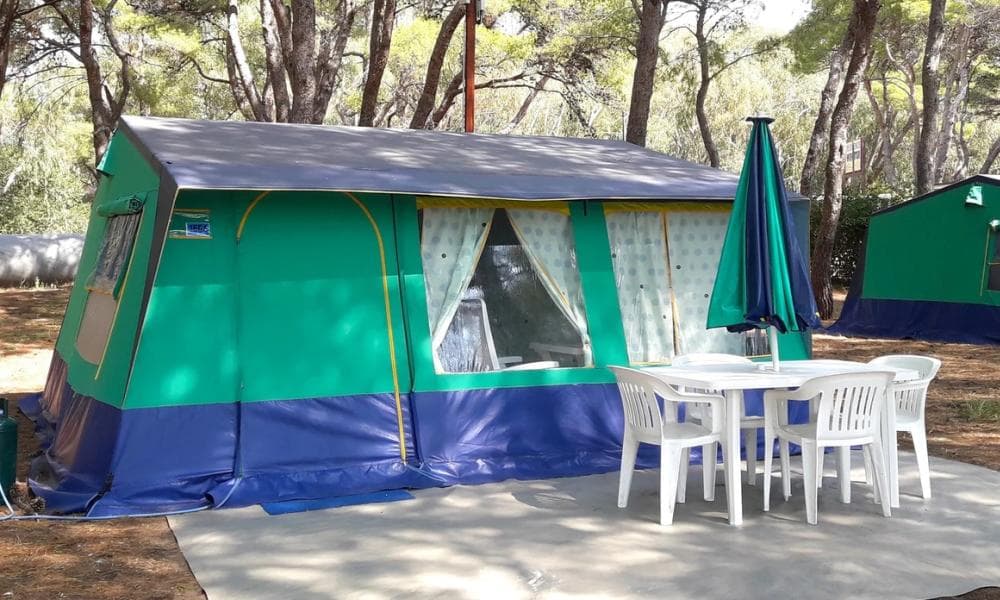
This is also where your choice of accommodation really shows. Pitching your own tent after some 1,300 km is a very different evening from arriving at one that's already up. With a Costa Tent bungalow tent, the tent is pitched and furnished before you arrive: make up the beds with the sheets you've brought, put the drinks in the fridge, and the holiday has begun.